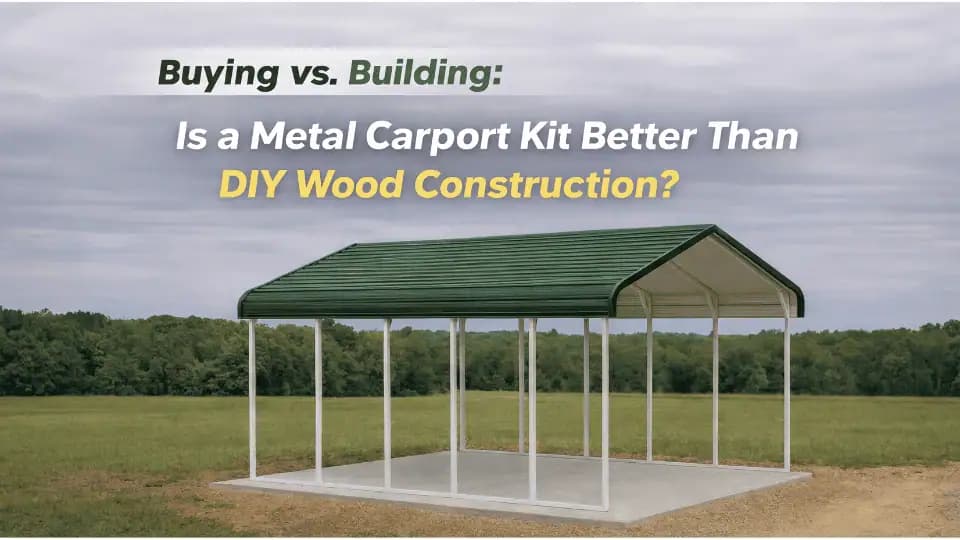
If you’re trying to add covered parking or equipment shelter, you’ve basically got two roads: buy a metal carport kit and assemble it, or build a wood carport from scratch. Both can work. The better choice comes down to how you value time, how serious your weather is, and whether you want “weekend project” or “long-term structure.” (And yes, local permitting and load requirements matter either way.)
Key Highlights
- Metal carport kits usually win on speed, predictable materials, and lower long-term maintenance.
- DIY wood can make sense if you already own the tools, enjoy carpentry, and want a fully custom look.
- Wind and snow performance is where “built right” matters most, and engineered/certified options can simplify permitting.
- Your site prep and foundation are just as important as the frame, no matter what you build.
- A quick “decision matrix” near the middle of this guide will help you pick fast.
Two Paths to the Same Goal
You’re not just choosing materials. You’re choosing how the project gets managed.
Metal carport kit
A metal carport kit is a pre-designed package that shows up with the structural pieces cut and matched to a specific size, roof style, and option set. The point is fewer “figuring it out on the fly” moments. Get Carports offers metal carport kits as a DIY-friendly option and notes you can get many designs as a kit, including custom or stock configurations.
DIY wood carport
A wood build is a custom construction job. You design (or adapt) plans, source lumber, choose connectors, set posts, frame the roof, and finish it. That also means you own the “problem-solving” when lumber is warped, a post hole hits rock, or your roofline needs a last-minute change.
Metal Carport Kit vs DIY Wood Carport (Quick Comparison)
Here’s the big picture before we get into the details.
| Factor | Metal Carport Kit | DIY Wood Construction |
| Build speed | Fast assembly once site is ready | Slower, more steps and measuring |
| Materials predictability | High (packaged components) | Variable (lumber quality varies) |
| Maintenance | Typically lower | Typically higher (paint/stain/rot checks) |
| Weather performance | Often available as certified/engineered options | Depends heavily on design + workmanship |
| Tools required | Usually fewer specialized carpentry tools | More carpentry tools, cuts, and fittings |
| Custom look | Modern/clean, lots of options | Traditional look, highly customizable |
| Best for | Farmers, contractors, homeowners who want “done” | Skilled DIYers who want full control |
Cost and Time: What Surprises People
Most folks assume the material choice is the whole cost. It’s not.
The cost you see vs the cost you feel
With wood, you can keep buying “just one more thing” for weeks: another bracket run, extra fasteners, a replacement board, a different stain, another saw blade. With a kit, costs are usually more defined up front, but you still have site prep and permitting.
Metal carport pricing changes with size, roof style, doors/windows, gauge, and location, and they share a broad reference range for some common configurations while emphasizing that prices vary.
What “your time” is worth (simple way to estimate)
If the job takes you 4 full Saturdays, that’s not just 4 days. It’s planning, supply runs, returns, cleanup, and weather delays.
A quick, practical formula
Total “real” cost = materials + tools/rentals + site prep + your time value + redo buffer
Pro tip
If you’ve got livestock, tenant vehicles, or jobsite crews depending on that covered space, “time to usable” is a real financial number, not a feeling.
Cost drivers that swing the decision
| Cost driver | Metal kit tends to | Wood-built tends to | Why it matters |
| Lumber/steel market swings | Be packaged/quoted | Require shopping and substitutions | Availability and price stability |
| Tooling | Need fewer carpentry tools | Need more cutting/framing tools | Upfront costs if you don’t own tools |
| Finish work | Less (often) | More (often) | Paint/stain/siding adds time and cost |
| Repairs over 10+ years | Usually lower | Often higher | Rot, pests, and repainting add up |
Performance and Longevity: Weather Is the Tie-Breaker
If you live where storms, snow, or heavy rain are normal, performance is where your decision gets real.
Wind and snow loads
A strong-looking structure is not automatically a load-rated structure. Wind uplift, racking (side-to-side sway), and snow load are engineering problems. Certified buildings are warranted to withstand specified wind and snow loads for 20 years, based on engineer-certified drawings provided at installation.
What “certified” usually helps with
- Getting through permitting with fewer back-and-forth questions
- Matching the structure to your region’s wind/snow requirements
- Reducing the guesswork on bracing and anchoring
Rot, termites, and moisture
Wood can last a long time when it’s built right and maintained. But it’s still vulnerable to:
- Ground contact and splash-back
- Termites and carpenter ants (region dependent)
- Warping, checking, and fastener loosening over time
Rust and corrosion
Metal structures are not “zero maintenance,” but they’re often lower maintenance. We offer a 20-year rust-through warranty on certain 12-gauge framing/roofing materials under normal care and maintenance, plus separate certified load coverage and workmanship terms.
Maintenance Reality Check
This is the part people forget to compare.
Annual maintenance checklist (both builds)
| Task | Metal carport kit | DIY wood carport |
| Check anchors and base points | Yes | Yes |
| Tighten/inspect fasteners | Occasionally | More often |
| Wash surface / remove debris | Yes | Yes |
| Repaint / restain | Rare to periodic (depends on finish) | Periodic, especially in sun/rain |
| Pest inspection | Lower risk | Higher risk |
Permits, Site Prep, and Foundation
No matter what you build, your structure is only as good as the ground it sits on.
What you’ll likely need either way
- Local permit requirements (setbacks, height limits, load requirements)
- Site grading and drainage planning
- A foundation plan (concrete pad, footings, or approved anchoring method)
Delivery and installation are included in their pricing, and that the buyer is responsible for planning the foundation and securing permitting.
Site prep mistakes to avoid
- Building in a low spot where water pools
- Skipping squareness and level checks
- Underestimating access for delivery, equipment, or materials staging
Customization: Where Kits Have Quiet Advantages
A lot of people assume “kit” means limited. In reality, many kits are modular.
You can customize metal carport kits with options like colors, windows, doors, roof styles, and size dimensions.
Roof style matters more than most people think
- Regular roof: budget-friendly in mild conditions
- A-frame: more “house-like” lines and trim
- Vertical roof: better water shedding and often preferred in harsher weather (varies by product and local requirements)
Common Mistakes
Mistakes with metal kits
- Ordering a size that fits today, but not tomorrow (new tractor, wider trailer, bigger truck)
- Ignoring roof style and drainage in tree-heavy or snow-prone areas
- Skipping proper anchoring and site leveling
Mistakes with wood builds
- Under-sizing posts or under-bracing corners
- Not accounting for uplift and lateral loads
- Building before confirming setbacks and permits
FAQs
Is a metal carport kit actually “DIY friendly”?
It can be, especially if you’re comfortable following instructions, squaring corners, and anchoring correctly. Get Carports positions their metal carport kits as a good fit for people who enjoy DIY projects.
Which is cheaper: a kit or building with wood?
It depends on lumber pricing, your tool costs, and how much you value your time. Kits often reduce uncertainty. Wood can be cost-effective if you already own tools and can source straight, quality lumber.
What’s the biggest durability difference?
Wood’s biggest enemies are moisture and pests. Metal’s biggest enemies are poor anchoring, poor site drainage, and corrosion in harsh environments. Warranty and certification details matter when you compare options.
Do I need a foundation for a carport?
You need an approved anchoring plan and a prepared site. Many buyers use concrete, footings, or other methods depending on local requirements. Get Carports notes foundation planning and permits are handled by the buyer even when delivery and installation are included.
Can I customize a metal carport kit?
Yes. Get Carports lists customization options such as colors, windows, doors, roof styles, and size dimensions for kits.
What if I want monthly payments instead of paying all at once?
Get Carports offers rent-to-own and financing options on their site, including a rent-to-own program that highlights no credit checks and instant approval (terms and limits apply).
Final Take: The “Best” Choice Is the One You’ll Finish
If you want covered space fast, with fewer moving parts and typically less long-term upkeep, a metal carport kit is hard to beat. If you love building, want a specific traditional look, and you’ve already got the tools and skills, DIY wood can be a satisfying project.
If you’re leaning metal and you’d rather skip the guesswork, Get Carports lets you choose a kit-style approach, and the site notes free delivery and installation plus certified-for-local-codes options.